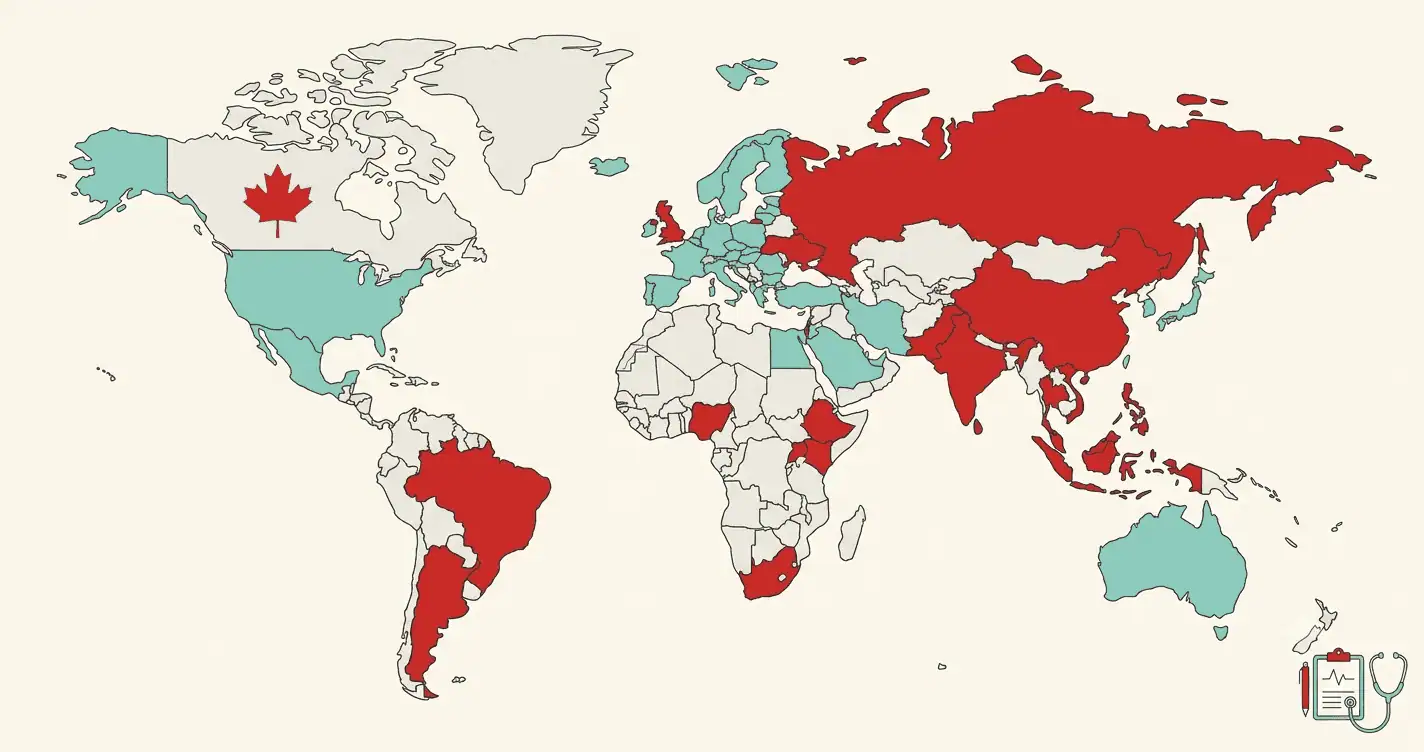
Not every applicant needs a medical exam – your country of origin is one of the key factors
Whether you need a Canadian immigration medical exam depends on more than just the type of application you are making. For temporary residents — people applying for work permits, study permits, or visitor visas — the requirement is largely triggered by your country of origin or travel history. IRCC maintains a designated list of countries whose nationals or recent residents must complete an IME before or during their application.
That list changed in November 2025. Four countries were added and six were removed, affecting thousands of applicants who submitted applications on or after November 3, 2025.
This guide explains how the country list works, what changed in the November 2025 update, which countries are currently on the list, and exactly what triggers the requirement for temporary residents. For a complete overview of the exam itself, see our complete guide to the Canadian immigration medical exam.
How the country list works
IRCC maintains a list of countries and territories whose nationals or recent residents are required to complete an immigration medical exam when applying for temporary residence in Canada. The list is reviewed periodically by IRCC in collaboration with the Public Health Agency of Canada (PHAC) and informed by data from the World Health Organization (WHO). Countries are added or removed based on changes in disease prevalence, public health risk assessments, and global health trends.
The list applies specifically to temporary residence applicants — visitors, students, and workers. The rules for permanent residence applicants are different and are covered separately below.
Being on the designated list does not mean every national of that country automatically needs an IME. Whether the requirement actually applies to you depends on your specific situation — how long you have been in or travelled to the country, what type of work you will do in Canada, and what permit you are applying for. The three specific triggers are explained in detail further below.
The authoritative source for the current list is IRCC’s official country requirements tool on canada.ca. Countries are listed alphabetically and updated whenever IRCC makes changes. Always check the official tool before submitting your application — do not rely on third-party lists, including this one, as your final confirmation.
The November 2025 update: what changed and who is affected
As confirmed by IRCC’s official announcement, changes to the designated country list took effect on November 3, 2025. Applications submitted before that date are not affected — the previous list continues to apply to those files.
Four countries added to the list:
- Argentina
- Colombia
- Uruguay
- Venezuela
Applicants who have lived in or travelled to any of these four countries for six or more consecutive months in the year before arriving in Canada must now complete an IME when applying for temporary residence. This applies to applications submitted on or after November 3, 2025.
Six countries and territories removed from the list:
- Armenia
- Bosnia and Herzegovina
- Iraq
- Latvia
- Lithuania
- Taiwan
Applicants from these six countries or whose recent travel history is limited to these countries will no longer need an IME for temporary residence applications, provided no other trigger applies to their situation.
IRCC routinely makes these adjustments to reflect evolving public health data. The additions and removals are not a reflection of immigration policy preferences — they reflect the Public Health Agency of Canada’s current assessment of disease prevalence and public health risk in each country based on WHO data and other sources.
Countries currently on the designated list (2026)
The full designated list contains more than 100 countries and territories. Rather than reproduce the complete list here — which changes with each IRCC update — the most reliable approach is to check your country directly using IRCC’s official country requirements tool, which lists all countries alphabetically with a clear yes or no indicator for the IME requirement.
Among the countries currently on the designated list as of November 2025 are:
Afghanistan, Algeria, Angola, Azerbaijan, Bangladesh, Belarus, Bolivia, Brazil, Cambodia, Cameroon, China, Côte d’Ivoire, Democratic Republic of Congo, Dominican Republic, Ecuador, Egypt, El Salvador, Ethiopia, Ghana, Guatemala, Guinea, Haiti, Honduras, India, Indonesia, Iran, Kenya, Laos, Madagascar, Malaysia, Mali, Mexico, Moldova, Mongolia, Morocco, Mozambique, Myanmar, Nepal, Nicaragua, Niger, Nigeria, North Korea, Pakistan, Papua New Guinea, Peru, Philippines, Russia, Rwanda, Senegal, Sierra Leone, South Africa, Sri Lanka, Sudan, Tanzania, Thailand, Togo, Tunisia, Uganda, Ukraine, Uzbekistan, Venezuela (newly added November 2025), Vietnam, Zambia, Zimbabwe — among others.
Argentina, Colombia, and Uruguay were also added in November 2025 and are now on the list.
Armenia, Bosnia and Herzegovina, Iraq, Latvia, Lithuania, and Taiwan were removed in November 2025 and are no longer on the list.
This is not an exhaustive list. Always verify your specific country using the official IRCC tool before making any assumptions about whether the requirement applies to you.
The three situations that trigger the IME requirement for temporary residents
Being from a country on the designated list does not automatically mean you need an IME. The requirement is triggered by one or more of the following three situations:
Trigger 1: Country of origin or travel history combined with length of stay.
You need an IME if you have lived in or travelled to one or more designated countries for six or more consecutive months in the year before arriving in Canada. Both conditions must be met: the country must be on the designated list, and your time there must have been at least six consecutive months within the twelve months immediately before coming to Canada.
A two-week holiday in a designated country does not trigger the requirement. Living in a designated country for eight months does, even if you are not a citizen of that country. A Canadian citizen who spent seven months working in a designated country before returning home would need an IME when applying for a new immigration document — the trigger is based on where you have been, not just your nationality.
Trigger 2: Occupation in Canada — regardless of country of origin.
Certain workers must complete an IME regardless of which country they are from or how long they have spent in designated countries. This applies to anyone coming to Canada to work in an occupation where protecting public health is essential:
- Healthcare workers — physicians, nurses, dentists, pharmacists, and allied health professionals
- Childcare workers and in-home caregivers
- Teachers and school staff who work directly with children
- Food handlers in food processing or food service settings
- Agricultural workers who have lived in or travelled to a designated country
If you fall into one of these occupational categories, you must complete an IME regardless of your travel history or nationality.
Trigger 3: Super visa applicants — regardless of country.
Parents and grandparents of Canadian citizens or permanent residents applying for a super visa must complete an IME regardless of their country of origin or travel history. The super visa IME requirement is unconditional.
Permanent residence applicants: a different set of rules
The designated country list applies specifically to temporary residence applicants. Permanent residence applicants are subject to a different framework — almost all permanent residence applicants must complete an IME regardless of which country they are from.
This means that even if your country is not on the temporary residence designated list, you will still need an IME if you are applying for permanent residence through Express Entry, family sponsorship, a provincial nominee program, or most other PR streams. Your country of origin does not exempt you from the PR medical exam requirement.
For Express Entry applicants specifically, the August 2025 upfront IME rule adds another timing dimension — the exam must be completed before submitting the application, not after. See our Express Entry upfront medical exam guide for the full process.
Who is exempt even if their country is on the list
Even if your country is on the designated list, the IME requirement may not apply to you in the following situations:
Short stays. If you are planning to stay in Canada for six months or less and are not working in a public health–sensitive occupation, you are generally exempt from the IME requirement — even if your country is on the designated list. The requirement is tied to length of stay, not nationality alone.
In-Canada applicants who qualify for the 5-year exemption. If you are already living in Canada, have completed an IME within the last five years, and your previous results were low risk or no risk, you may be exempt from completing a new exam under IRCC’s temporary public policy extended until October 5, 2029. See our 5-year IME exemption guide for the full eligibility criteria.
Diplomatic and official visa holders. Certain diplomatic and consular staff, and holders of official visas, are exempt from the IME requirement.
Applicants whose country was recently removed from the list. If your country was removed from the list in November 2025 — Armenia, Bosnia and Herzegovina, Iraq, Latvia, Lithuania, or Taiwan — and you had not yet submitted your application before that date, the requirement no longer applies to your temporary residence application provided no other trigger applies.
What to do if your country is on the list
If you confirm that the IME requirement applies to your situation, here are the steps to take:
Step 1: Verify on the official IRCC tool. Go to IRCC’s country requirements tool and check your country. Confirm whether the requirement applies based on your specific situation — country, length of stay, and occupation.
Step 2: Find an approved panel physician. Only IRCC-approved panel physicians can perform your exam. You can use a physician anywhere in the world — you are not required to use one in your home country or in Canada. Use the IRCC Doctors directory to find approved physicians near you. If you are based internationally, find physicians in India, Australia, or the USA, or search for any other country worldwide.
Step 3: Factor the IME into your application timeline. For most temporary residence applications, IRCC will send you a medical instruction letter after you submit — you do not need to complete the exam before applying unless you are an Express Entry applicant. When you receive instructions, book promptly. Clinics in major cities typically have a one to two week wait. Read our step-by-step guide to what to bring to your appointment before heading to the clinic.
Frequently asked questions
Find a panel physician near you
Use the IRCC Doctors directory to find an approved panel physician in your city or country. You can complete your immigration medical exam anywhere in the world — use these direct links to find physicians in the most commonly searched locations:
Panel physicians in India Panel physicians in Australia Panel physicians in the USA Panel physicians in Ontario Panel physicians in British Columbia Panel physicians in Alberta
Or search the full directory for any city or country at irccdoctors.ca/all-listings.
Last updated: May 2026. The designated country list is updated periodically by IRCC. Always verify the current requirements using the official IRCC country tool before submitting your application.