Introduction
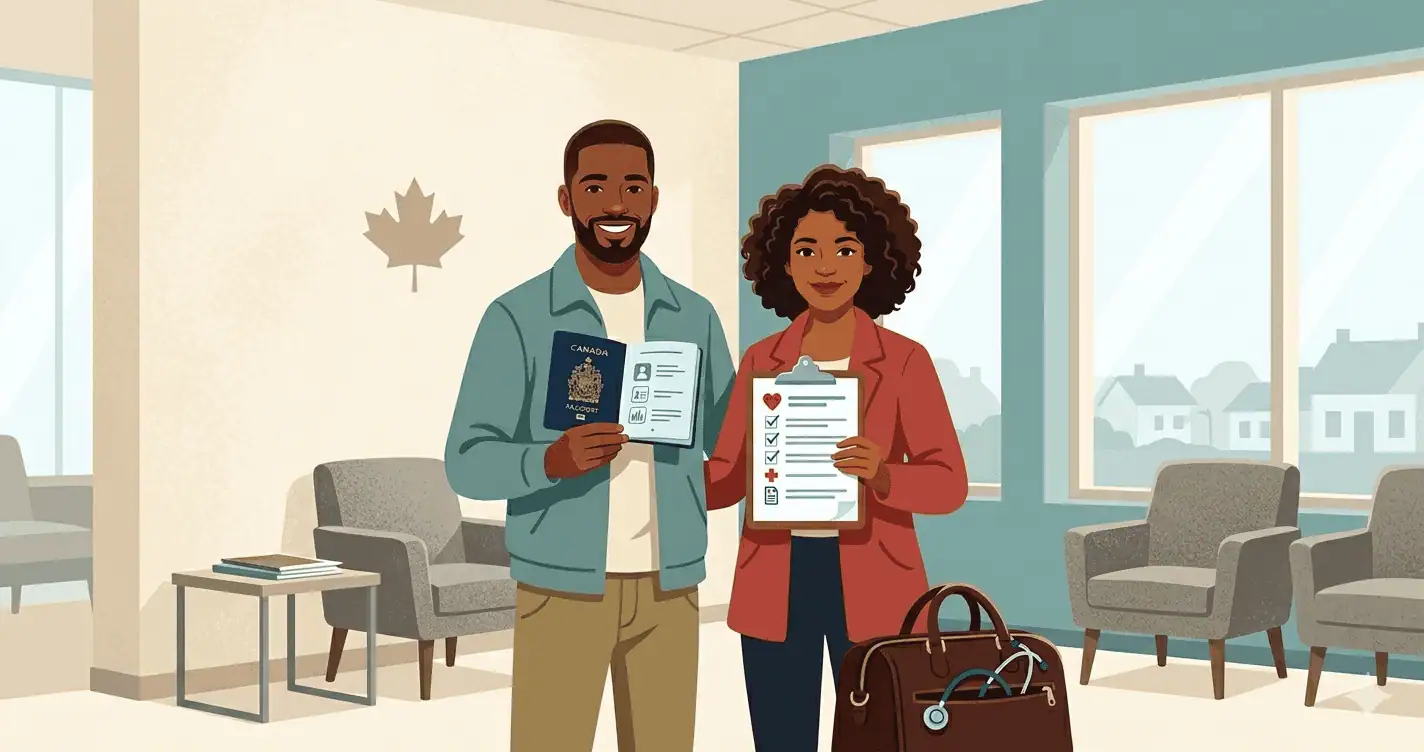
Arriving at your immigration medical exam without the right documents can get your appointment cancelled — and set your application back by weeks. Panel physicians cannot complete your exam without proper identification, and in some cases missing a document means you need to rebook and pay again.
This checklist covers everything to bring, organized by applicant type, so you can walk in prepared and walk out with your proof of completion in hand.
For a full walkthrough of what actually happens at the appointment, see our complete guide to the Canadian immigration medical exam. For tips on how to prepare in the days before your appointment, see our immigration medical exam preparation guide.
The essential checklist — required for all applicants
These items are non-negotiable. Every applicant regardless of age, immigration stream, or country of origin must bring them.
Original valid passport
Your passport is the primary identity document used to verify your identity and link your exam to your IRCC file in the eMedical system. It must be:
- Original — a photocopy, scan, or certified copy is not sufficient
- Valid — not expired
- For the correct person being examined — each family member needs their own passport at their own appointment
A driver’s licence, national ID card, or birth certificate alone is not sufficient. If your passport has expired and you are in the process of renewing it, contact your panel physician before your appointment to discuss options.
Glasses or contact lenses (if you wear them)
Vision is assessed as part of the physical examination. If you wear prescription glasses or contact lenses for reading, driving, or everyday use, bring them. The physician assesses your corrected vision — if you normally wear correction and do not bring it, your vision results may not accurately reflect your functional eyesight.
List of current medications
Bring a written list of every medication you currently take, including:
- The full medication name (generic and brand name if known)
- The dosage
- How often you take it
If you take the physical medications with you, bring them. The packaging or label showing the medication name and dosage is helpful if you cannot remember the details. Do not omit any medication — including over-the-counter medications taken regularly, supplements, or mental health medications. If a substance appears in your blood or urine test that was not disclosed, it raises questions about transparency.
Payment
The immigration medical exam is not covered by provincial health insurance. You pay the panel physician directly. Bring the correct payment method — some clinics accept only cash and debit, and do not accept credit cards. Confirm the clinic’s accepted payment methods and the total cost for your age group when you book. See our immigration medical exam cost guide for a breakdown of what to expect to pay.
Bring if you have them — strongly recommended
These are not strictly required at every clinic, but bringing them will make your appointment smoother and more accurate.
Vaccination records
The panel physician will review your vaccination history as part of the medical history questionnaire. Bring any vaccination records you have — your yellow WHO vaccination booklet if you have one, printed vaccination records from your doctor or local health authority, or digital records if accepted by the clinic.
Vaccination records are reviewed and noted but vaccination itself is not mandatory. You will not be refused entry to Canada or fail the exam because you are missing a vaccination. However, gaps in your vaccination record may result in a recommendation or follow-up.
Medical records for pre-existing conditions
If you have been diagnosed with, treated for, or hospitalized for any medical condition — past or present — bring relevant records:
- Diagnosis letters or reports
- Hospital discharge summaries
- Test results (blood work, imaging, biopsies)
- Specialist letters
This is particularly important for conditions involving the lungs (including any past TB diagnosis or treatment), kidneys, heart, liver, or mental health. Bringing documentation allows the panel physician to contextualize findings and reduces the likelihood of unnecessary follow-up requests from IRCC.
List of past surgeries and hospitalisations
If you have had surgery or been admitted to hospital, note the reason, the year, and the outcome. You will be asked about this in the medical history questionnaire.
Children’s health records (for applicants bringing children)
For child applicants, bring their vaccination records, any records of significant childhood illnesses or hospitalisations, and — for children over 5 — be prepared for a urine sample. Children over 11 will require a chest X-ray and children over 15 will require blood tests.
Additional items for specific applicant types
Express Entry applicants (upfront IME)
If you are completing an upfront IME as part of an Express Entry application, you do not need to bring an IMM 1017 form — this form is only issued for non-upfront medicals where IRCC has sent you a medical instruction letter. For upfront medicals, contact the panel physician directly and bring your passport and the items listed above.
After your exam, the physician will give you either an Information Printout Sheet or an IMM 1017B Upfront Medical Report form. Keep this document — you must upload it when submitting your Express Entry permanent residence application.
Applicants who received an IRCC medical instruction letter (non-upfront)
If IRCC has sent you a medical instruction letter after you submitted your application — the process for family sponsorship, most work and study permits, and other non-Express Entry streams — bring:
- IMM 1017E or IMM 1020E — the medical report form sent to you by IRCC. Some clinics require this; others work from your IRCC file number alone. Bring it regardless.
- The instruction letter itself, which includes your unique client identifier (UCI) number
Refugee claimants and IFHP beneficiaries
Refugee claimants whose immigration medical exam is covered by the Interim Federal Health Program (IFHP) should bring:
- Refugee Protection Claimant document — this serves as your primary photo ID if you do not have a passport
- Acknowledgment of Claim document
- IFHP Blue Cross coverage confirmation — bring this to verify your coverage before any fees are charged. As of May 2026, immigration medical exams remain fully covered at no cost for eligible IFHP beneficiaries
Pregnant applicants
Inform the clinic of your pregnancy when you book and again when you arrive. A chest X-ray is still required — the clinic will use a lead shield to protect the fetus. Bring any prenatal records or documentation of your pregnancy if available.
Applicants with a disability or accessibility needs
You are entitled to bring a chaperone or support person to your appointment. Inform the clinic when booking if you require any accessibility accommodations — a translator, a support worker, or physical accessibility requirements — so they can prepare.
What you do NOT need to bring
Several common misconceptions cause applicants to arrive with things they do not need, or to worry unnecessarily.
Passport photos. Panel physicians using the eMedical system — which is now standard across Canada and most international clinics — take your photo at the clinic using their own equipment. You do not need to bring passport photos. If you are unsure, confirm with your specific clinic when booking.
Your own doctor’s referral. You do not need a referral from your family physician. You book directly with the panel physician.
Fasting. You do not need to fast. Eat and drink normally before your appointment. Drink plenty of water — you will need to provide a urine sample.
Results of previous IRCC medical exams. If you are claiming the 5-year exemption for in-Canada applicants, you need your IME number or previous IMM 1017B — but otherwise, previous exam results do not need to be brought to a new appointment.
Your own medical equipment. If you use a CPAP machine, hearing aids, or other medical devices, you do not need to bring them to the exam. If relevant, mention them to the physician during the history questionnaire.
Before you leave the house — a quick checklist
Use this as your final check before heading to your appointment:
Required for everyone:
- [ ] Original valid passport (for each person being examined)
- [ ] Glasses or contact lenses if worn
- [ ] Written list of all current medications with dosages
- [ ] Payment (confirm method — cash/debit/credit — when booking)
Bring if you have them:
- [ ] Vaccination records
- [ ] Medical records for any pre-existing conditions
- [ ] Records of past surgeries or hospitalisations
- [ ] Children’s health and vaccination records (for child applicants)
Bring if applicable:
- [ ] IMM 1017E or IMM 1020E (non-upfront medicals only — if sent by IRCC)
- [ ] IRCC medical instruction letter with your UCI number (non-upfront)
- [ ] Refugee Protection Claimant document (refugee applicants)
- [ ] IFHP Blue Cross coverage confirmation (refugee claimants)
What to expect when you arrive
When you arrive at the clinic, the panel physician or clinic staff will:
- Verify your identity against your passport and photograph you for your eMedical file
- Ask you to complete a medical history questionnaire
- Conduct the physical examination
- Collect urine sample (age 5+), blood sample (age 15+), and chest X-ray (age 11+)
The full appointment typically takes two to four hours. All tests are done in a single visit at most clinics. Results are submitted electronically to IRCC — you will not receive a copy.
At the end of your appointment you will receive either an Information Printout Sheet or, for upfront Express Entry medicals, an IMM 1017B form. Keep this document safe — it is your proof of completion.
Frequently asked questions
What happens if I forget my passport? Your appointment will likely need to be rescheduled. Panel physicians cannot verify your identity without your original passport, and proceeding without identity verification means results cannot be correctly linked to your IRCC file. Contact the clinic as soon as possible if you realize you have forgotten it.
Can I use a driver’s licence instead of a passport? A driver’s licence alone is not sufficient as primary ID. Your passport is required. If you do not currently have a valid passport, contact the clinic before your appointment to discuss what alternatives may be accepted.
Do I need to bring my IMM 1017 form for an Express Entry upfront medical? No. The IMM 1017 form is only issued for non-upfront medicals where IRCC sends you a medical instruction letter. For Express Entry upfront medicals, no form is needed — contact the panel physician directly to book.
Do I need to bring my own interpreter? Most clinics in major Canadian cities have multilingual staff. Use the IRCC Doctors directory to find panel physicians who speak your language. If your language is not available at nearby clinics and you need an interpreter, confirm with the clinic whether they can accommodate one before your appointment.
Can I bring a family member or friend for support? Yes. You are entitled to bring a chaperone or support person to your appointment. Let the clinic know when booking.
What if my child refuses to give a blood sample? Inform the panel physician. They will manage the situation with the child’s comfort in mind. In rare cases where a test genuinely cannot be completed, the physician will document the circumstances and advise on next steps.
Do I need to bring the IMM 1017 form for my non-accompanying dependant? If IRCC has issued a medical instruction for a non-accompanying dependant, bring the relevant form and instruction letter for their appointment. Requirements are the same as for accompanying family members.
Find a panel physician near you
Use the IRCC Doctors directory to search for an IRCC-approved panel physician in your city or country. Each profile includes contact details, languages spoken, and in many cases pricing — so you can confirm costs and payment methods before your appointment.
Last updated: May 2026. Requirements may vary by clinic — always confirm what to bring directly with your panel physician when booking.