Category Policy & Admissibility

A doctor reviewing a chest X-ray on a light board with a patient during a Canadian immigration medical exam tuberculosis screening

Immigration Medical Exam and Tuberculosis: Tests, Results, and What Happens Next

Tuberculosis is the primary public health condition IRCC screens for at the Canadian immigration medical exam — and the only condition that triggers a mandatory post-arrival monitoring requirement. This guide explains what the chest X-ray checks for, what each of the three possible TB-related results means for your application, and exactly what the medical surveillance process looks like if inactive tuberculosis is found.

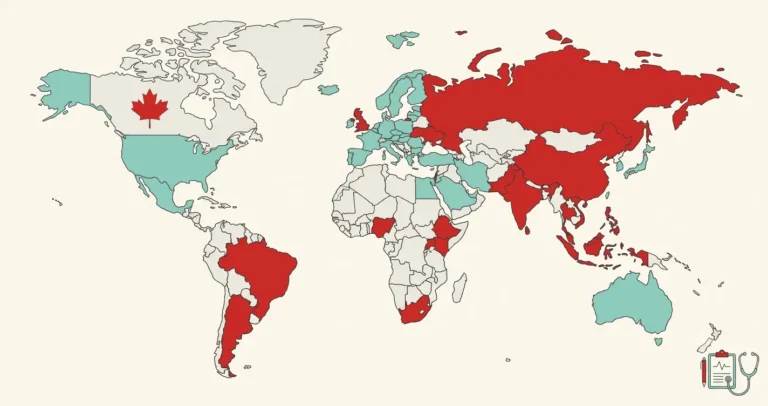
A world map with countries highlighted in red and teal indicating which countries require an immigration medical exam for Canadian immigration as of the November 2025 IRCC update

Countries That Require a Medical Exam for Canadian Immigration (Updated November 2025)

IRCC updated its designated country list for immigration medical exams in November 2025 — adding Argentina, Colombia, Uruguay, and Venezuela while removing Armenia, Bosnia and Herzegovina, Iraq, Latvia, Lithuania, and Taiwan. More than 100 countries remain on the list. This guide explains how the country list works, which three situations trigger the IME requirement for temporary residents, and what to do if your country is on the list.

A woman holding an approval stamp beside a five-year calendar illustrating the IRCC 5-year IME exemption for in-Canada immigration applicants who completed a previous medical exam within the last five years

The 5-Year IME Exemption for In-Canada Applicants: Who Qualifies and How to Claim It (2026)

Already living in Canada and applying for permanent or temporary residence? You may not need to complete a new immigration medical exam. IRCC's temporary public policy exempts eligible in-Canada applicants from a repeat IME if they completed one within the last five years and their previous results were low risk — and the policy has been extended until October 5, 2029. This guide covers the four conditions you must meet, how to claim the exemption, and what to do if IRCC determines you do not qualify.

A magnifying glass over a document showing a dollar sign on a desk with a stethoscope and Canadian flag illustrating the 2026 excessive demand cost threshold for Canadian immigration medical inadmissibility

The $28,878 Excessive Demand Threshold Explained (2026)

Canada's 2026 excessive demand threshold is CAD $28,878 per year — the benchmark IRCC uses to determine whether a health condition would place too great a burden on Canada's publicly funded health and social services. This guide explains exactly what the threshold means, how it is calculated, which conditions typically trigger it, who is exempt, and what to do if you receive a procedural fairness letter giving you 90 days to respond.