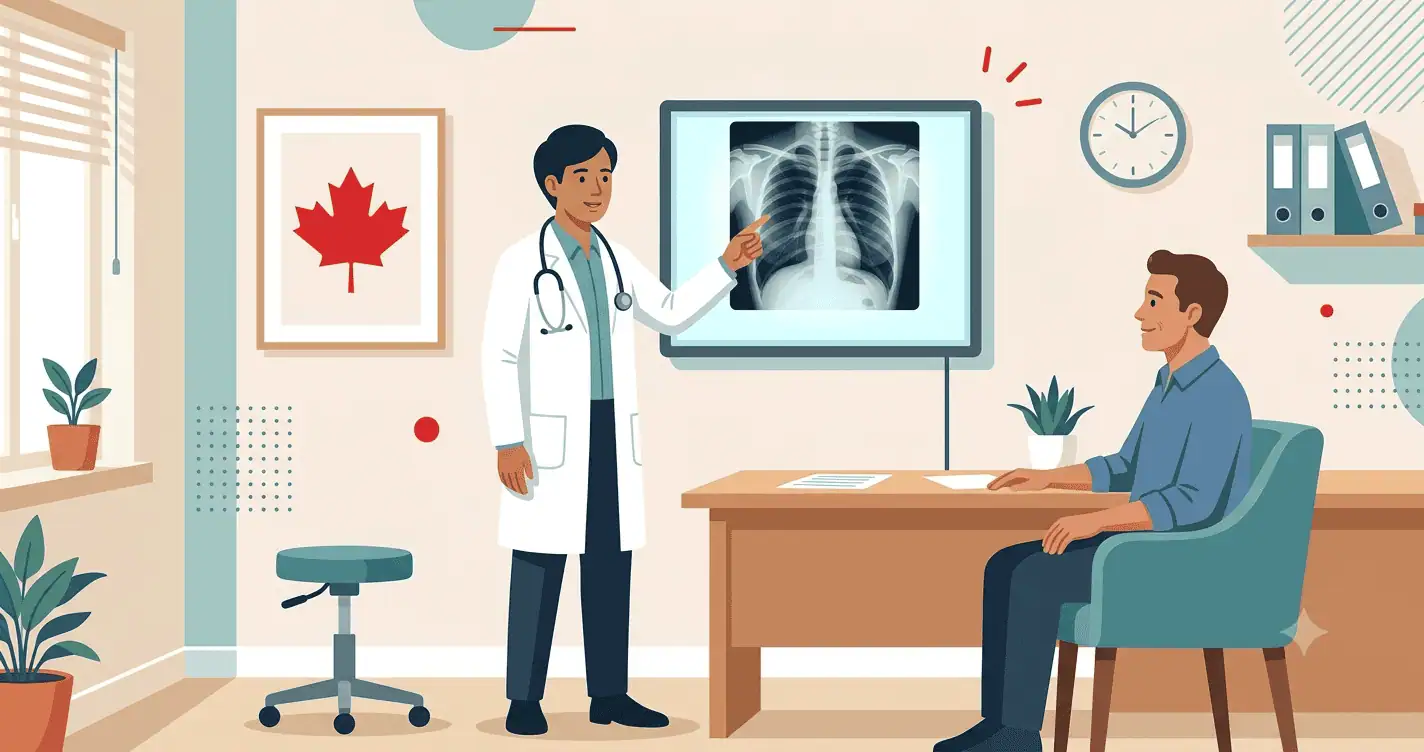
TB is the condition IRCC screens for most carefully at the immigration medical exam
Of all the health conditions assessed during the Canadian immigration medical exam, tuberculosis receives the most systematic attention. It is the primary public health condition that the chest X-ray — required for every applicant aged 11 and older — is designed to detect. It is the only medical condition for which IRCC currently requires post-arrival monitoring. And it is one of the most anxiety-inducing findings applicants encounter, in large part because most people do not understand what a TB-related result actually means for their immigration application.
This guide explains exactly how tuberculosis is screened during the immigration medical exam, what the three possible outcomes are, what active and inactive TB mean for your application, and what the medical surveillance process looks like if it applies to you.
For a full overview of everything that happens at the immigration medical exam — including all the other tests and components — see our complete guide to the Canadian immigration medical exam and our step-by-step walkthrough of the appointment.
Why Canada screens so carefully for tuberculosis
Tuberculosis is a bacterial infection caused by Mycobacterium tuberculosis. When active in the lungs or throat, it spreads through the air when an infected person coughs, sneezes, or speaks — making it one of the most contagious communicable diseases that immigration health screening is designed to intercept.
Canada screens for TB at the immigration medical exam because many of the countries with the highest volumes of immigration applicants also have significantly higher rates of TB than Canada itself. Residents and visitors to Canada who were born in high-TB-incidence countries account for over two-thirds of all reported TB cases in Canada. Screening at the point of immigration is one of the most effective interventions available for protecting Canadian public health — but it also serves the applicant, by identifying a treatable condition they may not have known they had.
The screening is not designed to exclude everyone who has ever been exposed to TB. Most people who test positive for exposure never develop active disease. The goal is to identify active infectious TB — which poses an immediate public health risk — and to monitor those with inactive TB who face a higher risk of future activation.
What the immigration medical exam screens for: the chest X-ray
The primary TB screening tool in the immigration medical exam is the chest X-ray, required for all applicants aged 11 and older. Pregnant applicants also require the X-ray — the clinic will use a lead shield to protect the fetus.
The X-ray is examined to look for characteristics consistent with three things: active pulmonary tuberculosis, inactive or healed tuberculosis, and other abnormalities that may suggest past TB infection or other conditions requiring follow-up.
It is important to understand what the chest X-ray in the immigration medical exam is and is not. It is a screening tool for pulmonary tuberculosis — TB affecting the lungs. It is not a tuberculin skin test (TST) and it is not an IGRA (interferon-gamma release assay) blood test. The skin test is not part of the standard immigration medical exam, primarily because BCG vaccination — common in many countries — causes false positive skin test results in a large proportion of applicants. The chest X-ray is the most reliable available method for detecting both active and inactive pulmonary TB in a screened population at this scale.
In some cases — particularly where the chest X-ray shows abnormalities and there are symptoms — the panel physician may also order sputum tests (TB smear and culture) as follow-up. This is not part of the standard exam but may be added where clinical findings warrant it.
The three possible TB-related outcomes
When your chest X-ray is reviewed — first by a radiologist at the clinic and then assessed by IRCC medical officers — one of three outcomes applies:
Outcome 1: Normal chest X-ray — no TB concerns
If your chest X-ray is normal and shows no findings consistent with active or inactive tuberculosis, no further TB-related action is required. Your results are submitted to IRCC and your application proceeds normally. This is the outcome for the majority of applicants.
Outcome 2: Inactive or healed tuberculosis detected — medical surveillance required
If your chest X-ray shows abnormalities consistent with previous or inactive tuberculosis — sometimes described as healed TB, old TB, or fibronodular changes — you receive medical clearance to proceed with your immigration application, but with a condition attached: you must complete medical surveillance after arriving in Canada.
Inactive tuberculosis means the TB bacteria are present in your body in a dormant state — they are not causing active disease and you are not infectious. You may have no symptoms at all. However, people with inactive TB face a higher risk of the infection reactivating into active disease at some point in the future — estimated to be four to six times higher than the risk for someone with no TB findings. Medical surveillance is designed to catch that reactivation early so it can be treated promptly.
Inactive TB detected during the IME does not make you medically inadmissible. It is not a refusal. It is a finding that triggers post-arrival monitoring — and that monitoring is the only additional obligation it creates.
According to research on immigration medical exam screening, inactive TB is detected in approximately 3% to 5% of all immigration applicants screened. It is common enough that panel physician clinics encounter it routinely.
Outcome 3: Active tuberculosis detected — entry deferred until treatment is complete
If your chest X-ray and follow-up testing indicate active pulmonary tuberculosis — meaning the infection is currently causing disease and you may be infectious — IRCC will not grant medical clearance until you have completed a satisfactory course of treatment.
Active TB is the finding that triggers medical inadmissibility on public health grounds. Applicants found to have active pulmonary TB must complete treatment under medical supervision before their application can proceed. Treatment for active TB typically involves a combination of antibiotics taken over a minimum of six months. Before medical clearance can be granted, IRCC requires evidence of completed treatment, three consecutive negative sputum smears and cultures, and chest X-rays showing stable or improving results.
Active TB that is treated to completion does not permanently bar someone from Canadian immigration — clearance is granted once treatment meets IRCC’s standards. However, the delay can be substantial. Contact investigation is also required: family members and close contacts who are also immigration applicants must be screened.
A follow-up chest X-ray may be requested
For applicants whose initial X-ray shows findings that are unclear — neither clearly normal nor clearly indicative of active disease — IRCC may request a follow-up chest X-ray at least three months after the initial exam. This allows the medical officer to assess whether the findings have changed, stabilized, or progressed, which helps distinguish between inactive and active TB more reliably. The follow-up must be done at or after the specified date — it cannot be done earlier than the date IRCC requests.
If IRCC requests a follow-up X-ray, you will receive written instructions with the details. Use the IRCC Doctors directory to find an approved panel physician who can conduct the follow-up X-ray, or return to the clinic where you had your original exam.
Medical surveillance after arriving in Canada
If your IME found inactive tuberculosis, medical surveillance is required after you arrive in Canada. As confirmed by IRCC’s official guidance, inactive tuberculosis is the only medical condition for which IRCC currently requires post-arrival monitoring.
Here is how the medical surveillance process works:
Notification. When you arrive in Canada, your provincial or territorial public health authority is notified of your medical surveillance requirement. In some cases, a document given to you at the port of entry will instruct you to report within 7 or 30 days — however, as IRCC now confirms, you can disregard that document if you receive it. You only need to provide IRCC with your contact information once you have a home address and phone number in Canada.
Contact from public health. The provincial or territorial public health authority will contact you to schedule your medical surveillance appointment. You do not need to initiate this contact — they will reach out to you. However, it is important that IRCC and the public health authority have your current contact information. If your address changes, update it promptly.
The surveillance appointment. The medical surveillance appointment involves a medical history and physical examination to assess for symptoms of active TB — cough lasting more than two to three weeks, unexplained weight loss, night sweats, fever, fatigue — along with a chest X-ray to compare against your pre-landing X-ray. If symptoms are present or the X-ray is abnormal, sputum samples may be collected for TB testing.
Compliance confirmation. Once you have completed your appointment, the public health authority notifies IRCC’s Public Health Liaison Unit. IRCC will email you within approximately two months to confirm that you have met the medical surveillance requirement.
If you are already in Canada when your IME is done. If you completed your immigration medical exam while inside Canada and were seen by a tuberculosis clinic at that time, you may not need a separate post-arrival medical surveillance appointment. The public health authority will notify IRCC’s Public Health Liaison Unit directly if this is the case.
If you travel outside Canada before completing surveillance. You must notify IRCC’s Public Health Liaison Unit by email at [email protected] before leaving Canada. Include your full name and UCI number. If you have symptoms of active TB, see a doctor before travelling.
What happens if you do not complete medical surveillance
Medical surveillance is a condition attached to your immigration clearance, not an optional recommendation. Non-compliance with the requirement can affect future immigration applications — including extensions, renewals, and permanent residence applications. If IRCC has a record of medical surveillance non-compliance on your file, it will be assessed as part of any subsequent application you make.
If you have difficulty attending your surveillance appointment — because of scheduling, relocation, or other circumstances — contact the provincial or territorial public health authority directly and explain your situation. They have processes for following up and rescheduling. Do not simply not attend without communicating.
Does inactive tuberculosis affect your immigration admissibility?
No. Inactive or healed tuberculosis found during the immigration medical exam does not make you medically inadmissible to Canada. It does not trigger an excessive demand finding — the treatment and monitoring costs associated with inactive TB do not typically exceed the excessive demand threshold of CAD $28,878 per year.
The only consequence of an inactive TB finding is the medical surveillance requirement after arrival. Your visa or permit is issued, you enter Canada, and you complete the surveillance appointment. That is the full extent of the obligation for the vast majority of applicants with this finding.
Active TB is different. It triggers a public health inadmissibility finding and defers medical clearance until treatment is complete — but even this is a temporary deferral, not a permanent bar, once treatment is successfully completed.
Frequently asked questions
Ready to book your immigration medical exam?
Use the IRCC Doctors directory to find an approved panel physician in your city or country. Each profile includes contact details, languages spoken, and in many cases pricing information.
If you have concerns about how a TB-related finding may affect your specific application, speak with a licensed immigration lawyer or authorized immigration consultant before your appointment.
Last updated: May 2026. Always verify current IRCC requirements at canada.ca before your appointment.